Every film begins with a gap. On one end, a filmmaker’s vision. On the other, a finished scene.
For more than a century, each major technological leap has narrowed that distance.
This week, a new AI model compressed it to seconds.
Fal, a four-year-old generative-media company, introduced H3 Max, an AI model that can create five seconds of video in about three and a half seconds. In the company’s tests, the next-fastest model took nearly 27 seconds to produce the same amount of footage.
Put simply: H3 Max can generate a video clip faster than someone can watch it.
Until now, creating AI video has been a stop-and-start process: describe what you want, wait a decent amount of time for the clip, review it, try again, and wait again. H3 Max is a big deal, because it makes this workflow feel more instant, more like a conversation. A filmmaker can describe an idea, see the result nearly immediately and test a different direction.
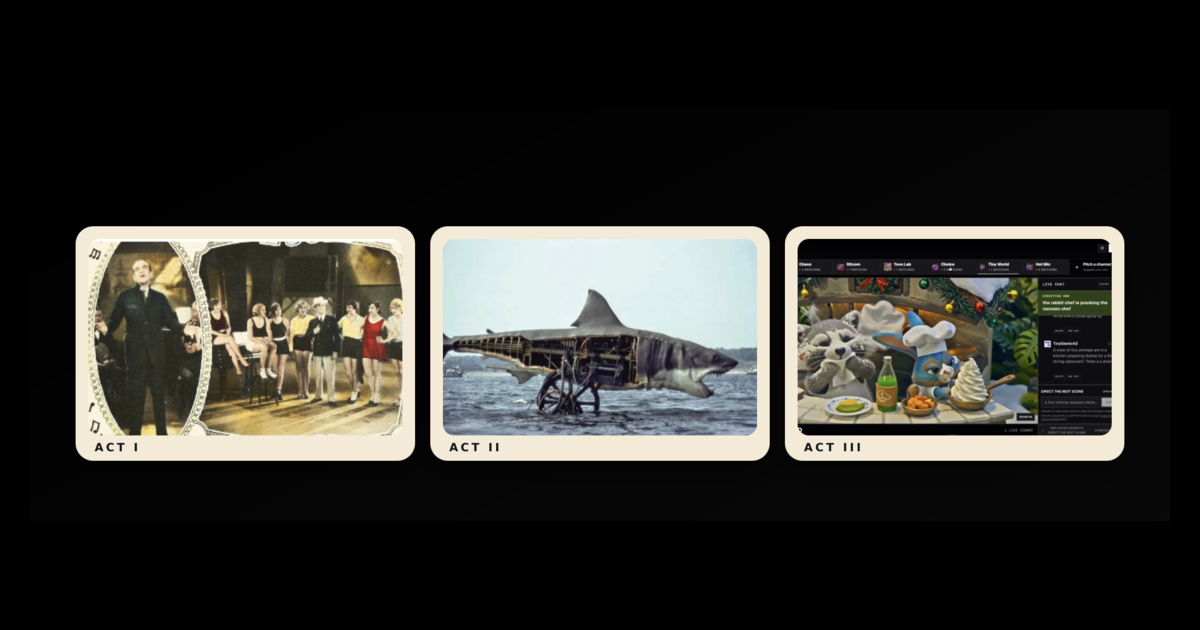
Within days of its release, developers were already using H3 Max to test new kinds of entertainment. Fal engineer Rehan Sheikh connected the model to a Twitch livestream that generated an endless sequence of surreal clips, creating what he compared to the “interdimensional television” in Rick and Morty. Developer Pieter Levels then built Infinite Slop, where viewers type ideas into a live chat and the model turns them into the next video, attempting to connect each new clip to the one before it.
These experiments point to a larger shift: filmmakers can now test scenes, settings and visual choices almost as quickly as they can imagine them. That does not remove the need for filmmakers. AI can generate footage, but storytelling still depends on human taste, judgment and intention.
AI is simply the latest technology to change Hollywood. Though sometimes fearful of change, the film industry has evolved over the decades to create better output. Soundstages gave filmmakers control over surroundings. Smaller cameras took them on location. Practical effects made imaginary creatures physical, while digital software made images editable. To understand where AI might take Hollywood next, it helps to look at the breakthroughs that brought us here.
The 1920s: From silent to synchronized sound
By the 1920s, Hollywood had built a thriving industry without recording a word of dialogue.
Silent film had already developed into a sophisticated art form. Filmmakers used close-ups, camera movement and editing to shape a story, while actors communicated through expression and physical performance. Title cards supplied the words, and musicians performed the soundtrack inside the theater.
Filmmakers never had to worry about noise on set. Cameras rattled. Directors called out instructions during a take. Crews worked just beyond the frame.
The introduction of synchronized sound changed that. In 1927, The Jazz Singer became the first feature-length film to include synchronized recorded dialogue. Much of the movie was still silent, but a handful of spoken sequences were enough to change what audiences expected.
For filmmakers, the breakthrough initially created as many problems as it solved. Early microphones had limited range, forcing actors to remain close to them. Cameras were so loud that they had to be sealed inside bulky soundproof booths. Performances became stiffer, and movies briefly became more static.
The limitations did not last. Studios invested in soundproof stages, quieter cameras and better microphones. Filmmakers learned how to record actors more naturally and use dialogue, music and sound effects as creative tools. By the early 1930s, synchronized sound had become the industry standard.
The 1960s: Smaller cameras move filmmaking beyond the studio
By the 1960s, Hollywood had mastered filmmaking inside a controlled studio. The cameras had advanced to produce more polished images; however, they were not easy to move. The Mitchell BNC, a workhorse of sound-era Hollywood, weighed roughly 135 pounds once enclosed to keep its mechanics quiet.
This beast of a camera was somewhat manageable on a soundstage. It was far less useful if a director wanted to follow an actor into the real world.
Portable 16mm equipment, lighter 35mm cameras and smaller sound systems coming on to the scene during this decade gave filmmakers a better option. These devices could travel with actors, operate in tighter spaces and enter locations that had never been designed for a film production.
The creative impact became clear in 1960 with Jean-Luc Godard’s Breathless. Cinematographer Raoul Coutard, a former war photographer, shot much of the film with a lightweight Caméflex camera and available light. During one well-known sequence, Jean-Paul Belmondo and Jean Seberg walk along the Champs-Élysées while Coutard follows them with a camera hidden in a postal cart. Pedestrians pass around the actors, largely unaware that a movie is being filmed.
That style helped define the French New Wave and influenced filmmakers far beyond France. Techniques that might once have looked like mistakes—uneven movement, natural light and people unexpectedly entering the frame—could make a film feel more intimate, spontaneous and connected to real life.
1975–1993: Practical effects make the impossible physical
By the 1970s, Hollywood’s ambitions were growing. Filmmakers wanted giant sharks, spacecraft, alien creatures and entire worlds that did not exist.
Effects teams met that challenge by building the illusion on set. They created animatronic creatures, miniature models, prosthetic makeup and elaborate sets, along with machines that produced rain, wind, explosions and destruction on cue. These practical effects allowed imaginary things to occupy the same physical space as the actors.
They became central to Hollywood’s emerging blockbuster era. For Jaws, Steven Spielberg’s team built three mechanical sharks, each designed for a different kind of shot. Nicknamed Bruce, they required as many as 14 operators—and rarely worked as planned. Saltwater corroded their mechanisms, contributing to a shoot that stretched from 55 to 159 days and a budget that nearly tripled to $9 million.
The malfunction ultimately improved the movie. Unable to show the shark as often as intended, Spielberg suggested its presence through a fin, a moving barrel and two notes from John Williams. Audiences imagined what the machinery could not reliably deliver.
Other filmmakers pushed practical effects in different directions. Star Wars turned miniature spacecraft and hand-built models into a galaxy. E.T. was an animatronic character capable of sharing a scene with human actors.
The success of these movies proved that spectacle could become a global cultural event. Studios invested larger budgets in directors who could build worlds audiences had never seen.
But every creature and world still had to be designed, built, transported, operated and repaired. If a filmmaker wanted something to move beyond the limits of the machinery—or needed to change the image after filming, practical effects could only go so far.
The 1980s–1990s: Software makes images editable
Practical effects could make imaginary creatures feel real, but they remained limited by what could be physically built and operated. Computer-generated imagery gave filmmakers another option: create or change parts of the image after filming.
The shift began with a few memorable experiments. In 1985, Young Sherlock Holmes featured one of cinema’s first fully computer-generated characters: a stained-glass knight that pulled itself free from a church window. Six years later, Terminator 2: Judgment Day introduced the T-1000, a liquid-metal assassin that could flow through prison bars, rise from a tiled floor and rebuild itself after a shotgun blast.
The T-1000 did not look like an effect placed on top of the movie. It reflected its surroundings and moved through the same physical spaces as the actors. It showed that a computer-generated character could deliver a performance.
Then Jurassic Park brought practical and digital effects together.
Animatronics handled the moments when dinosaurs needed to share physical space with actors: a sick Triceratops breathing beneath Laura Dern’s hand, a raptor claw tapping against a kitchen floor and the T. rex lowering its head toward a stranded vehicle. Computer-generated dinosaurs took over when the creatures needed to run, leap or move in ways that a full-size machine could not.
The achievement was not that audiences noticed the CGI. It was that they stopped wondering which parts were real.
That combination became Hollywood’s dominant approach. Filmmakers could build what actors needed to touch, photograph what already worked and use software to create or change everything else. A partial set could become a city. Hundreds of extras could become an army. A green screen could become another planet.
The finished image no longer had to exist when the camera stopped rolling. But it still took significant time to create. Visual-effects artists had to model, animate, light and combine each digital element with the filmed footage. A few seconds onscreen could require weeks of work across multiple teams.
2026: Generative AI makes filmmaking more immediate
Generative AI is the latest technology to change what filmmakers can create and how quickly they can see an idea take shape.
Traditional visual-effects software gives artists tools to construct and change an image. Generative AI can produce one from a written description, still image or reference clip. The first result is rarely final. Characters may change between shots, movement can look unnatural and a visually impressive clip may not serve the story. What has changed is how quickly a filmmaker can try again.
Fal’s H3 Max brings that process closer to real time. A director can test a setting, camera movement or visual style in seconds, respond to the result and explore another direction. That could make AI useful not only for finished footage, but for storyboarding, previsualization and the early creative decisions that shape a production.
The experiments appearing around H3 Max suggest more radical possibilities, including entertainment that responds to an audience while it is being watched.
Hollywood has been through this pattern before. Synchronized sound did not eliminate visual storytelling. Smaller cameras did not replace soundstages. Digital effects did not make practical effects obsolete. Each technology became another tool filmmakers could use and made human judgment more important in deciding when and how to use it.