AI art discourse online tends to swing between two extremes: people calling it the death of creativity, or people flooding the internet with low-effort generated content.
But the artists actually shaping this space are much more interesting than either of those narratives.
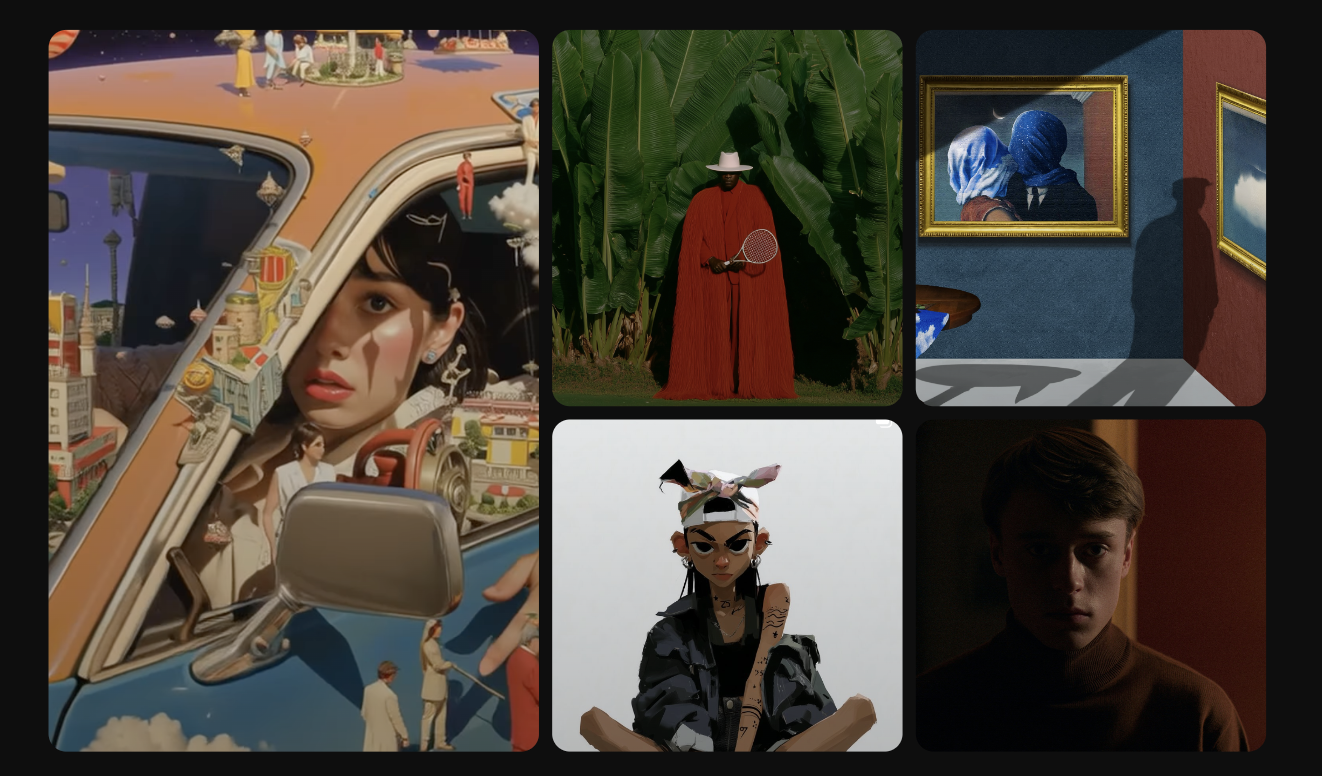
The most compelling AI-native creators aren’t using it to shortcut originality. They’re using it to build entire visual universes. A single image can evolve into a campaign, a film, a fashion world, a collectible character, a print series, a merch line, an installation, or entirely original creative IP.
And most of the people leading this shift don’t come from traditional AI or tech backgrounds. They’re creative directors, designers, photographers, filmmakers, architects, and internet obsessives experimenting with tools that finally match the scale and speed of their ideas.
What’s emerging around this scene also feels very different from traditional art worlds. Artists openly share prompts, workflows, editing techniques, references, and experiments. Some creators post entire breakdowns explaining how they achieved a specific visual effect. Others release prompt systems, cinematic frameworks, or reusable aesthetics for the broader community to build on.
And while there’s still plenty of generic AI content online, the artists breaking through tend to share the same thing: a strong point of view. The tool matters less than the taste behind it.
These creators aren’t just generating images.
They’re building worlds.
Gizem Akdag
With nearly 420K followers on Instagram, Gizem Akdag has become one of the breakout stars of the AI-native art world. The Turkish creative director and “AI explorer” creates dreamlike cinematic images that blend architecture, fashion, sports, and dreamlike landscapes into a distinct visual style.
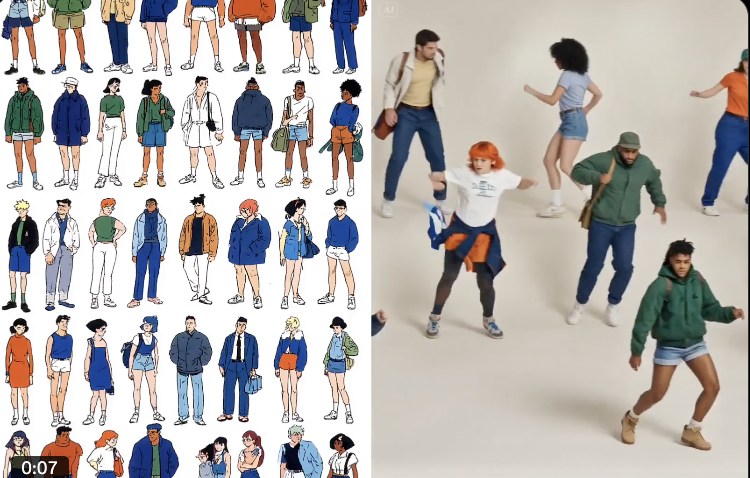
Her work often feels less like standalone AI images and more like fragments from larger worlds: uncanny portraits, strange environments, recurring color palettes, and characters that feel pulled from an alternate universe. In one recent project, she used a single image of herself to generate an entire consistent visual aesthetic using Adobe Firefly, describing the process as “building a visual language and applying it” rather than generating random images.

That sense of authorship is what separates Gizem from the flood of generic AI imagery online. Before AI, she spent years in architecture, branding, and creative direction, experience that now shows up in the precision, balance, and emotional consistency of her work.
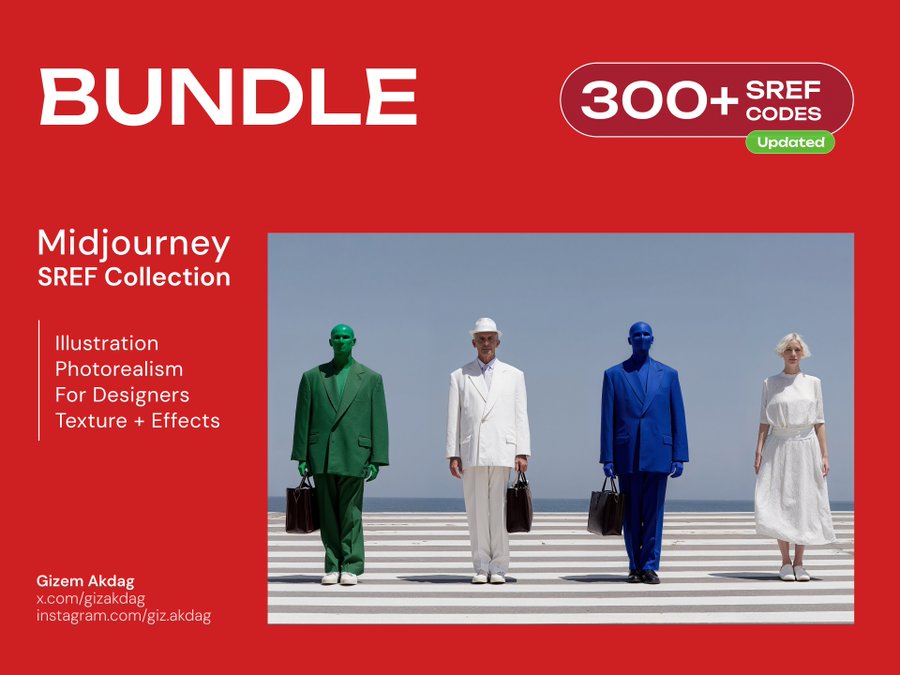
Increasingly, Gizem’s work operates less like a traditional art practice and more like a creative ecosystem. Beyond posting images, she’s launched curated Midjourney SREF collections — visual systems built from years of experimenting with aesthetics, prompts, and composition — turning years of aesthetic experimentation into systems other creators can build from.
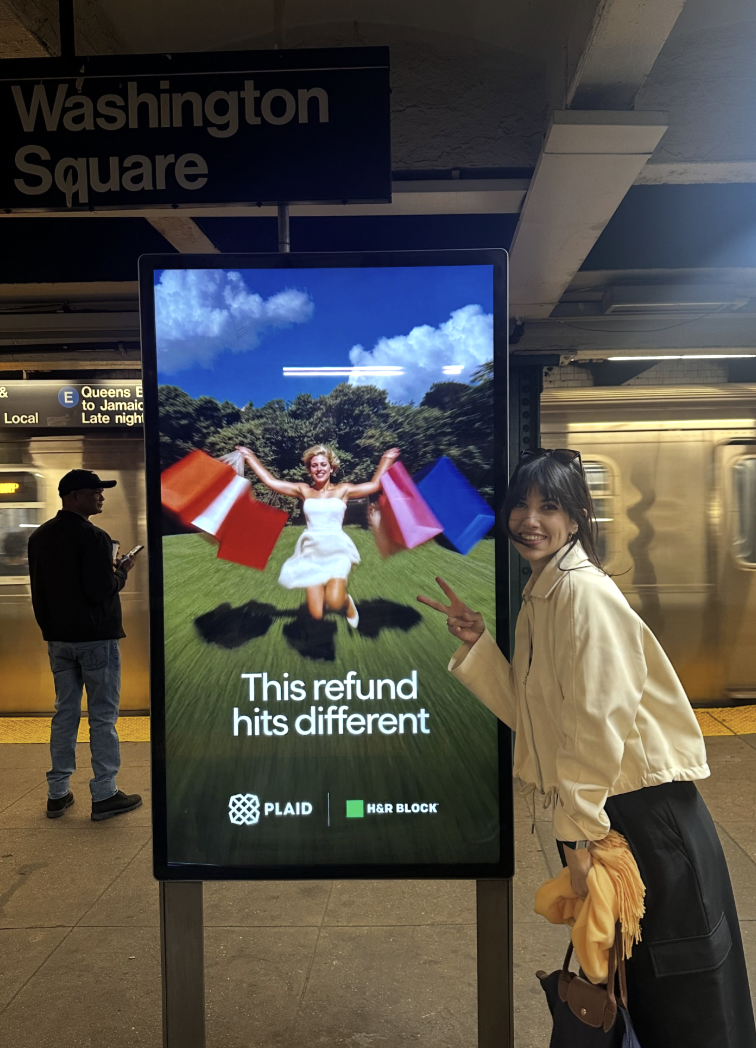
Her visuals have already crossed into the physical world through brand collaborations, including a recent campaign for Plaid that appeared throughout the New York subway system.
Gizem has also spoken openly about the controversy surrounding AI art, emphasizing that she avoids copying other artists or using their names in prompts, instead starting from scratch. “It’s not about replacing creativity,” she said in a recent interview for Athleta mag. “It’s about expanding what creativity can be.”
Ronald Ong
A duck fused with a banana. A zebra wrapped in Oreo cookies. A blurry Windows loading screen hovering over a digitally melting face captioned: “i think i’m spiraling.”
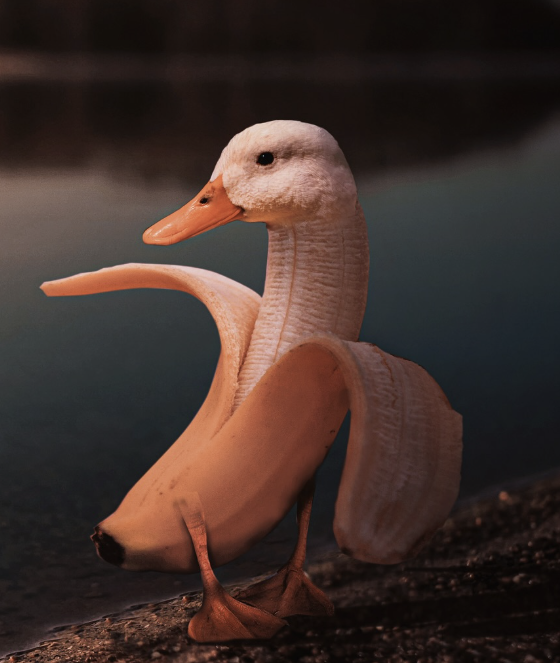
Ronald Ong’s work captures a very specific internet-era emotional language: funny, slightly unsettling, self-aware, and deeply online all at once.
The Malaysian artist—who also works full-time as a radiology doctor—first built an audience through manipulated photography before expanding into AI-assisted digital art exploring identity, memory, anxiety, and digital culture. His work blends photography, collage, illustration, and AI into images that feel emotionally driven rather than purely technical.
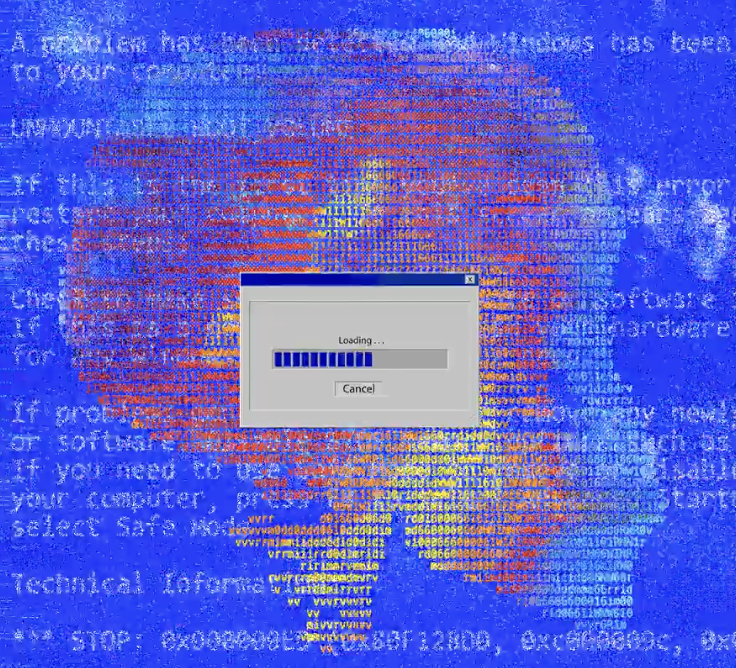
Despite his understated bio (“not taking art seriously”), Ronald has become one of the more established names in AI-native digital art, with work featured by Sotheby's and platforms like SuperRare. He was also an early breakout success in the NFT art world, selling work and building an audience of hundreds of thousands while early in his medical career.
What makes Ronald interesting isn’t just the visuals themselves, but the emotional tone underneath them. Even the more absurd images tend to carry a sense of anxiety, isolation, or digital overstimulation beneath the humor.
“There are no real rules to making art,” Ong said in an earlier interview about his rise online. “You just have to have a strong concept and execution.”
Charles (INK)
Charles (better known online as INK and 0xyung) had always wanted to create his own superhero, ever since he was a kid The dream was realized— across Claude, Midjourney, Runway, and Freepik—after what he described as “the best creative experience I’ve ever had.”
Charles is part of a growing class of AI-native creators treating generative tools like full creative studios. He’s the Lead AI Designer for ORES Collective — a collective focused on AI-native visual storytelling, exhibitions, and experimental digital art — and a curator and artist at Aigorithm, an AI production house working across commercial campaigns, exhibitions, and AI-native creative work.
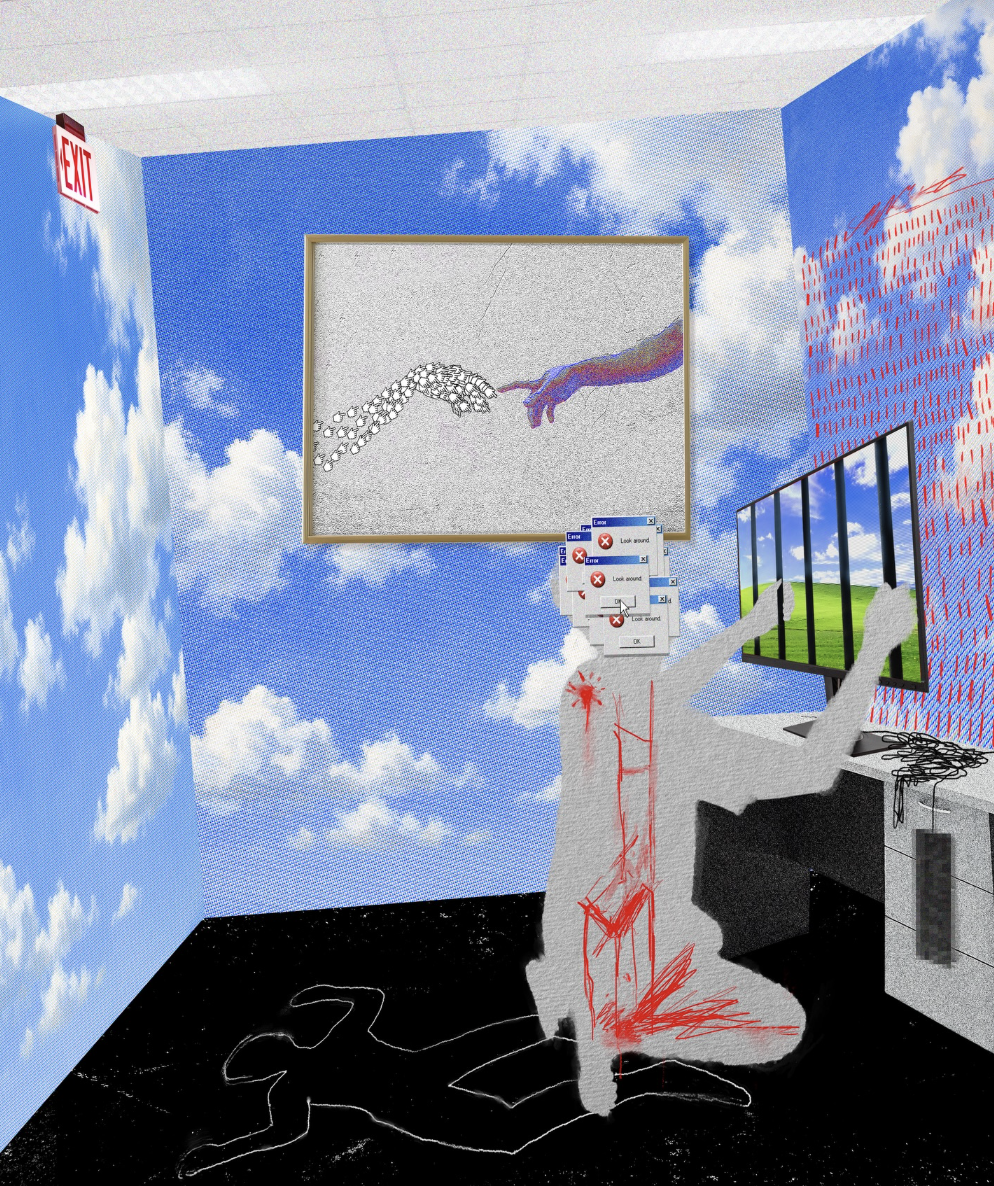
Charles openly shares the process he uses alongside finished work. In one X post, he published his entire cinematic Seedance workflow, breaking down film stock references, lens choices, camera behavior, sound design, motion sequencing, lighting, and scene structure almost like a modern filmmaking template for AI-native creators.
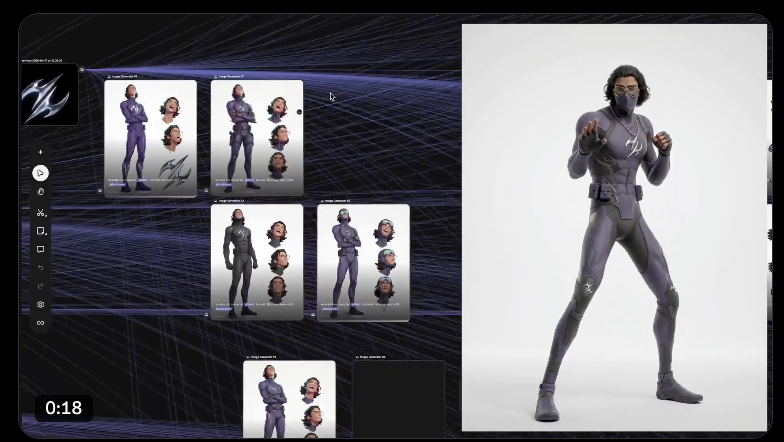
That transparency reflects a broader shift happening in AI-native creativity right now. Many of the strongest creators aren’t gatekeeping process. They’re experimenting publicly, sharing workflows in real time, and collectively pushing the medium forward faster than traditional creative industries typically move.
At the same time, Charles pushes back hard on the idea that AI creation is effortless. “People think you just press a button and it generates, but for us it’s much different,” he said in a recent profile. “It takes a lot of time and effort.”
For Charles, the real differentiator isn’t the tool itself, it’s taste.
“Your taste is what separates you,” he said. “Taste is what tells you, out of the hundreds, if not thousands of pieces of material that you encounter in your creative process, which to utilize and which to discard.”
That mindset also explains why so much AI-native work is starting to move beyond internet experiments into real commercial creative work. Charles and the team at Aigorithm have already created fully AI-generated films and campaigns for commercial clients, including an opening film for the France–Vietnam Chamber of Commerce gala built using Midjourney, Nano Banana Pro, and Kling.
Infiniteyay
Before diving into AI-native art, Infiniteyay spent more than 15 years building visual identities for brands like Adidas, Nike, Google, and Valentino — while in the background, struggling to make time for his own art.
Then he found AI tools in 2022 and, by his own description, became “enthralled” by their ability to finally translate the worlds in his head into visuals.
“These are my wildest dreams,” he wrote recently.
The Japan-based American artist now creates densely layered worlds that blur fantasy, nostalgia, architecture, advertising, and surrealism into scenes that feel suspended somewhere between dreams and reality. A woman’s face becomes an entire cityscape. Suburban neighborhoods float through the clouds. Hidden figures and tiny visual details reveal themselves the longer you stare.
In interviews, he’s explained that collections often involve generating thousands of images, manually sorting through them, then heavily editing and compositing the strongest pieces using Photoshop, After Effects, and other tools.
“There is also a massive curation effort done in my collections,” he told OpenSea. “I’ll create many thousands of images and manually sort through them all to find the strongest images to work with as a base.”
The work also pushes back on the idea that AI art is effortless. The technology may accelerate execution, but the differentiator still comes down to composition, editing, and storytelling.
“I really just hope to inspire people to tap into the magical side of life more,” he said. “To dream more and think outside of the box.”
OAK
You know the dreamy, swirly blur that vintage Helios 44-2 lenses give old films? OAK — an anonymous creator out of Riyadh — recreated that feeling entirely through prompting, referencing aperture, anamorphic bokeh, depth of field, and lens rendering with the specificity of a cinematographer obsessing over physical camera gear.
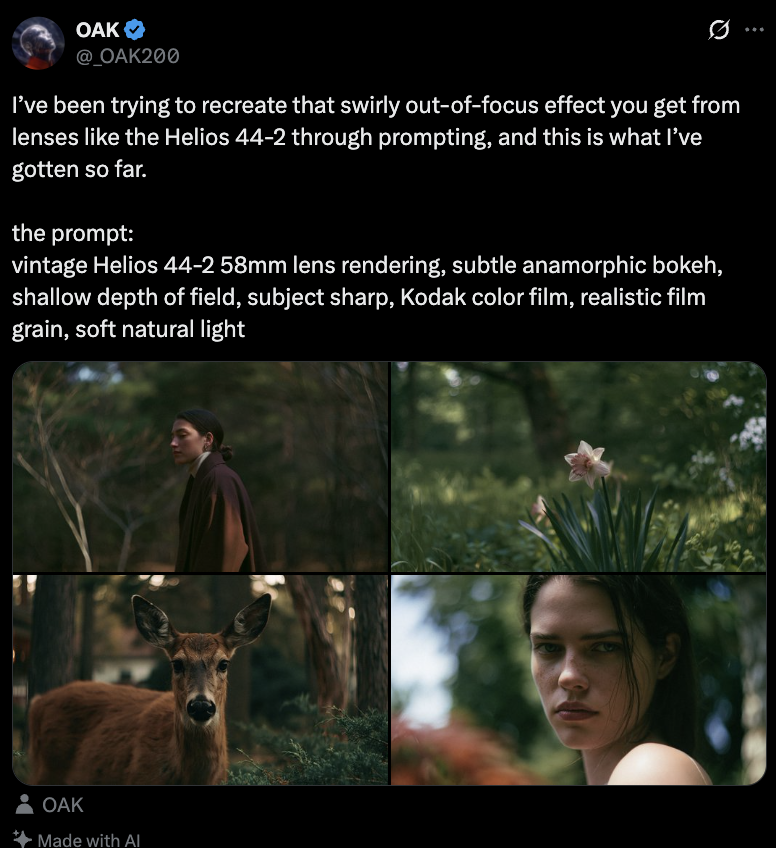
That attention to cinematic texture is what makes OAK’s work stand out. While a lot of AI-generated imagery online still feels overly polished or synthetic, OAK’s visuals chase something softer and more atmospheric: imperfect focus, natural light, film grain, motion blur, visual tension..Under the bio “cinematic frames & visual stories,” OAK has built a following creating moody AI-native short films and still imagery that feel pulled from half-remembered films or fashion editorials. Forest scenes drift in and out of focus. Subjects feel caught mid-thought. Oceans move like living paintings.
OAK is also open about process, frequently sharing exact prompting structures, camera references, and workflow breakdowns with other creators online.
Studio Misoo (Zeynep Aldemir)
What if Rolex teamed up with Casio? What if Jacquemus released a Magnum ice cream? What if Miu Miu made crochet knits for dogs?
These kinds of imaginary collaborations and ad campaigns have become a genre unto themselves online, generating millions of views and, in some cases, influencing conversations around real products. Few creators have embraced the format more successfully than Istanbul-based creative producer Zeynep Aldemir, the founder of Studio Misoo.
Through a steady stream of AI-generated "hype ads" and speculative campaigns, Aldemir creates products that don't exist but feel like they could. Each concept is clearly labeled as fictional, yet rendered with the polish of a luxury advertising campaign. The result sits somewhere between fan culture, creative direction, and market research, revealing the products and partnerships consumers wish brands would actually make.
Aldemir sees AI not as a shortcut but as a new creative medium. "AI doesn't create on its own. It responds to vision," she wrote recently. "You still need to know what you want to say and how to guide it there." For creators without access to studios, production teams, or large budgets, she argues, AI offers a new way to bring ambitious ideas to life.
What began as creative experimentation has evolved into professional opportunity. Aldemir has said that major brands have reached out about her work, and at least one commercial project has already emerged from the speculative campaigns she originally created for fun.
Lloyd Creates
“AI has removed the friction,” AI-native creator Lloyd wrote recently on his Substack. “It’s easy for anyone to prompt and generate but very few can see.”
That idea — that taste, perspective, and creative direction matter more now, not less — runs through almost everything Lloyd Creates makes.
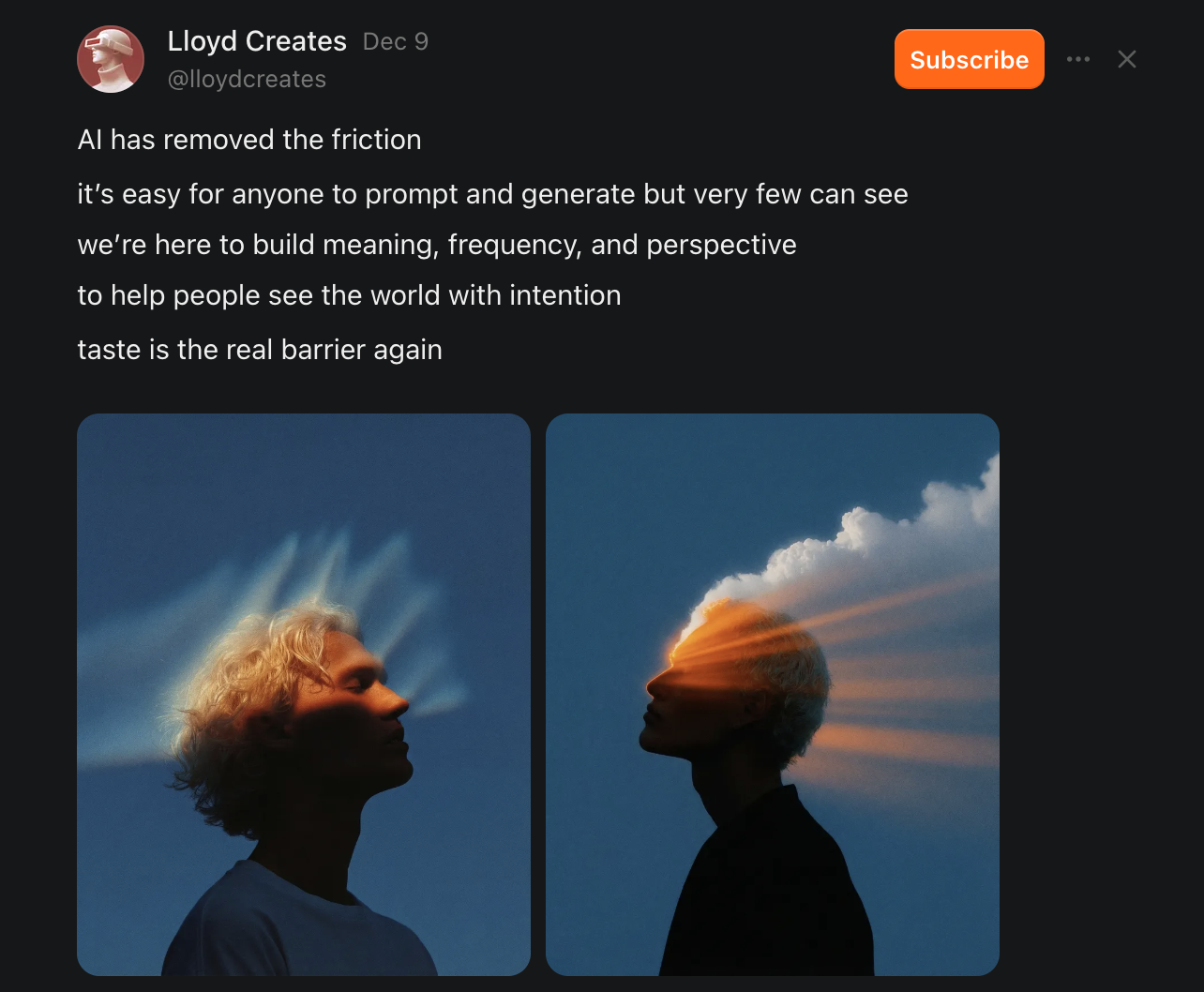
Part visual artist, part creative technologist, Lloyd’s work spans cinematic imagery, motion experiments, speculative design, and AI-native storytelling built across an evolving stack of tools including Krea, Topaz Labs, Weavy, Flora, Magnific, and Reve.
But what makes the work interesting is the restraint and visual cohesion behind the works.
His imagery feels highly intentional about mood and color: glowing monochromatic cityscapes, dreamlike landscapes, soft gradients, reflective surfaces, surreal lighting. The compositions often feel somewhere between luxury campaign visuals, sci-fi concept art, and ambient internet worlds.
At the same time, Lloyd is also unusually vocal about the bigger shift happening underneath all of this. In one post, he argued that film school once taught people to manage crews — but the next generation will manage agents instead.
“The one-person studio you’ve been waiting for isn’t coming,” he wrote. “It’s here.”