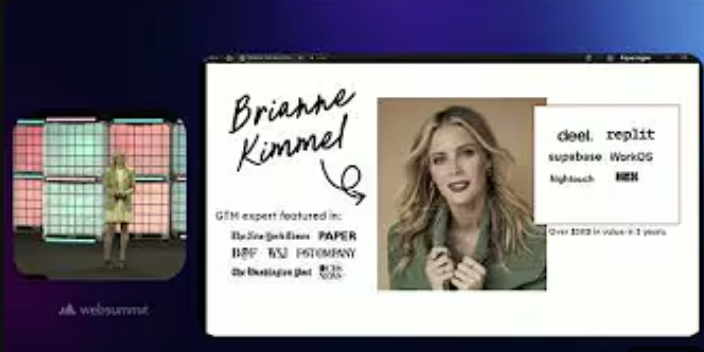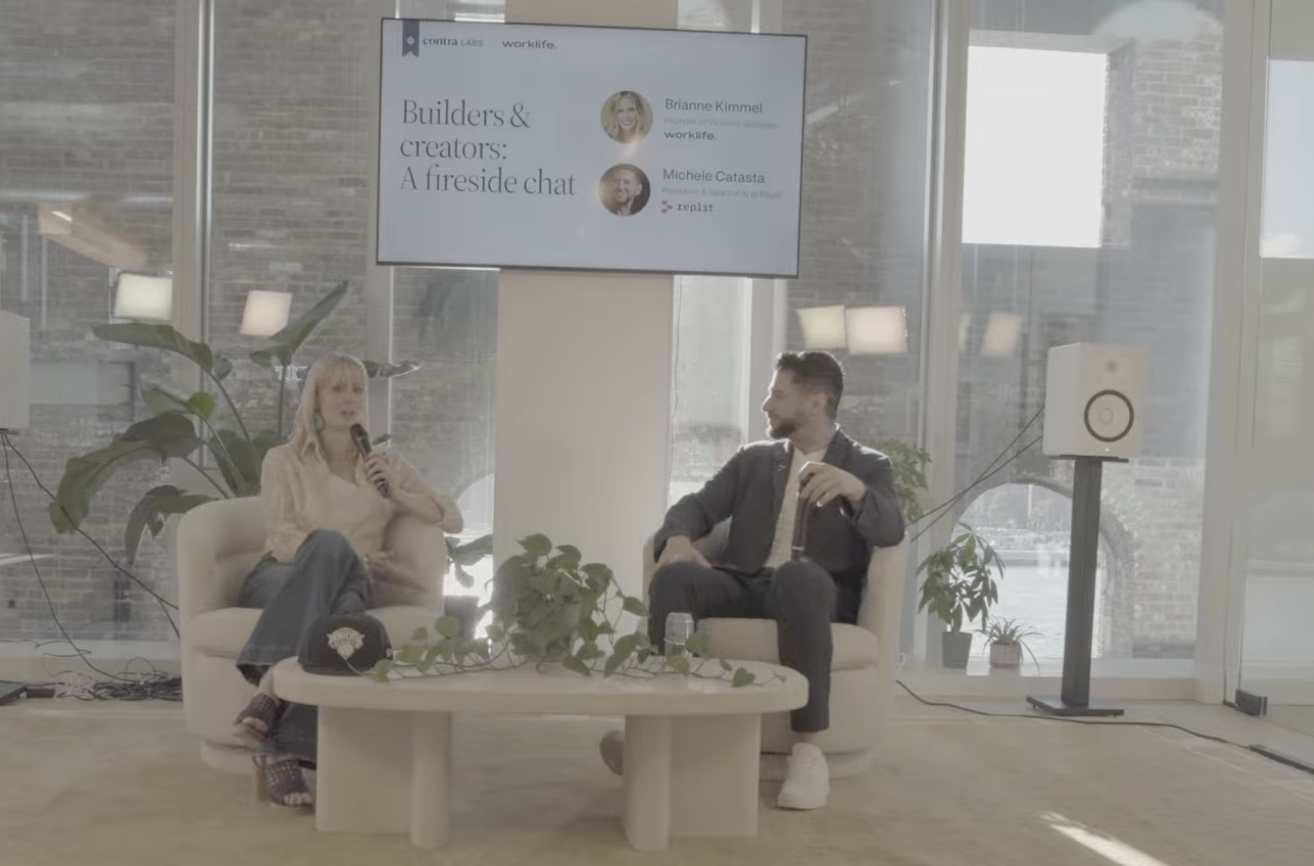
Recorded in New York City on Friday, June 19th, hosted by Contra. Brianne Kimmel, founder of Worklife Ventures, in conversation with Michele Catasta, President and Head of AI at Replit. Lightly edited for clarity. Full conversation here.
Brianne: I'm excited to be joined by Michele Catasta, President and Head of AI at Replit. We're both in town from San Francisco. These last two days have been at VibeCon, Replit's first push into culture-plus-code—a great mix of conversations, workshops, and dialogues with both technologists and fine artists. I left feeling inspired. There were installations and artists with strong opinions on where the world is going, and it was the first tech event I've been to that was also an honest conversation about the pros and cons of AI.
Part of our goal today is to talk about what's actually possible with AI right now, and some of the constraints we're seeing in the industry—while keeping it upbeat and fun. Michele, thanks so much for joining.
Michele: Of course, thanks for inviting me—and thanks to the Contra team. It's been great to collaborate with Contra and to be in this space.
The ten-year overnight success
Brianne: Replit got started long before "vibe coding" was even a topic of conversation. I'd love to hear about your background and what it was like when you joined.
Michele: It was a ten-year overnight success, basically. The company started in 2016, and for many years it was grind over grind over grind. The early focus was education—we were sending the product to schools.
The mission has always been to empower the next generation of creators. But there was a key piece missing in the stack: the idea that having to write code is itself the barrier to software creation. No matter how easy you make writing code, the fact that you have to learn it at all is the thing people didn't care about. Plenty of business creators and founders who don't come from tech were still hitting that wall.
So my personal mission, as a researcher, was rooted in AI and software engineering. I dreamed of a day when anyone could create software—not just the few tens of millions of developers running the world. It took about eight years to go from being passionate about it to seeing the first real glimpse, which came in September 2024 when we launched the first version of our product. That was a few months before the term "vibe coding" even entered the conversation.
We were very early, and the reason it's grown so rapidly is that the underlying infrastructure was finally ready—after years of waiting for AI to become powerful enough to make this kind of product possible. Since then it's been a lot of fun, a lot of growth, and a lot of the pain that comes with growth. We should talk about that today, because growth isn't always a measure of fun.
Brianne: It's been fascinating to watch Replit go from a Silicon Valley success story to a platform used by over 60 million people—the majority of them non-technical. I think we both share the vision that, in the future, anyone should be able to be a founder. I started Worklife in 2019 to back companies that make that possible—whether you're founding a podcast, a food truck, or a technology company. We just believe work life is better when you're self-employed, doing something you love, and getting paid fairly for it.
So when you reach that level of scale, what are the internal philosophies that keep the product intuitive enough for non-technical people to build?
"We're not building this for us"
Michele: Six months before that initial launch, the company was tiny—barely 60 people, almost exclusively technical folks. A few executives, the co-founders, our head of design. The vast majority of us were AI researchers and software engineers.
So one of the first principles I kept repeating was: we're not building this for us. Don't get excited about what we're building because you'd use it daily. Get excited because we're building something for people who've never written a single line of code in their lives—people who are going to have their first "aha" moment when their software runs for the very first time.
As we grew, that became part of the company's DNA. Every designer we hire, every PM, keeps reminding us daily that this is the most important principle we follow. Our ideal customer is the knowledge worker—a group nobody else was really talking about, and it's worked well.
There's a constant tension between design quality and engineering. Early on I struggled with it myself, because I spent my whole career on the technical side, with a fixation on moving fast and shipping as soon as possible—which the AI space forces on you anyway. Things move so fast that if you wait even a few days, your product is already deprecated. But over time I've learned to value the teams that pull the handbrake and say, "No, we need to take our time on user journeys, we need to do the interviews to understand whether this is actually exciting for our customer." That tension can feel like your startup is slowing down. In reality, it's exactly what keeps you on track.
One product, no segmentation
Brianne: We have a lot of design and product leaders in the room. With that range of users, how do you think about segmentation internally—if you do at all?
Michele: My segmentation is no segmentation. We have one core product, and we try to make it useful for everyone—from someone who doesn't even know what vibe coding is (and we relish explaining what the technology can do) all the way to the advanced enterprise customer who's been vibe coding for a year and a half, doesn't worry about what they're spending, and wants the latest feature the moment it ships.
I follow this principle because I want users to grow on our platform for as long as possible. Where Replit is today, you don't have to go anywhere else. We sit right between the AI developer tools—the Claude Codes and Cursors of the world—and the pure prototyping and website-creation tools like Webflow. Being in the middle is a great opportunity and a real challenge: we're building something unique, but we have to make sure it stays usable for everyone.
Building the company on agents
Brianne: As an early-stage VC, I meet companies all the time presenting themselves as AI-native or AI-first, and a lot of teams trying to figure out how far they can push agents to do real jobs. How is Replit using agents internally, and what jobs are they actually doing?
Michele: I'd like to believe we're AI-native at this point, even though we predate the term. The way we've made that real is simple: I've asked everyone to use the product as much as possible. A year ago that wasn't far enough along for everyone—today, every single team at Replit has built internal tools on our own product. When I open my laptop, more than half the tabs in my browser are Replit tools we use internally. Dogfooding isn't just good practice; it forces us to build a better product.
As we've grown, we've also realized that when we're negotiating with a vendor whose product doesn't quite fit how we work, it's often easier to just build the thing ourselves from the ground up. That's happening across every team—not just engineering, but HR, marketing, and sales too. Our PMs' jobs have been completely revolutionized over the past year or so.
Brianne: It's funny—I tell my investors and founders that the majority of our business runs on Replit, and they're often surprised. As a VC firm, a lot of our work has historically been outsourced: a fractional CFO, a fund admin, all kinds of services. By bringing it onto Replit, you save a lot of money. We've moved dashboards, presentation-building, and all sorts of jobs that used to go to a freelancer or contractor in-house, and now we own them end to end. Do you have other examples of companies running their whole business this way?
Michele: SaaStr comes to mind. Jason built his entire stack on Replit, and we were part of the recent revamp. The whole event runs on Replit—tools and agents he built himself for everything from marketing to registration. On stage during his keynote, he said he could never have run an event at that scale, in that span of time, without being able to spin up an agent.
Brianne: That reminds me of the conversation between Spike Jonze and Amjad, Replit's CEO, at VibeCon. It's interesting how creatives think about AI as a tool. In a lot of tech circles there's this grand vision that agents will do all the jobs. Spike's perspective was different—AI is a tool that helps you do certain jobs, but it doesn't replace creativity. SaaStr is a great example: Jason can run a multi-day conference and have a whole business-development machine handling vendor contracts and back-office work that founders hate doing. I've seen the same with artist friends who scale their businesses without hiring an MBA or a business manager—self-made, self-taught creators selling their own work.
So where does the agent workforce go from here? How far can a solo founder take this?
Michele: Really far. Today we're barely 300 people, and every time I share that with an investor they're shocked, because of the size of the business, the user base, the complexity of the product. So much of what we've built is automated by agents, and it cuts across every function—and we've barely started. The models only reached the level where we could automate this kind of work about six months ago, and there's no sign of slowing down. At the same time, the right products are finally being built on top of those models.
There's no more exciting time to work at a small company, because you don't inherit all that organizational debt or the old-school ways of doing things—you can get it right from day one. Even Replit occasionally has to clean up legacy from incorporating ten years ago. But if I were starting from scratch today, the rule would be: try to build a tool or an agent first; if that fails, then hire a person. That doesn't mean we've stopped hiring—we brought on about 120 people in the last six months, which is how fast we're growing. But without all that software around us, we'd probably need a thousand people.
Why Silicon Valley need more specialists, not generalists
Brianne: From an early-stage perspective, I hear a lot that founders want well-rounded generalists. Now that you've reached scale but want to keep the team lean, how do you balance generalists versus specialists?
Michele: I'm going to beg everyone: please don't just become a generalist. There's a narrative that this is the best time in history to be one, and it's not wrong—if you're planning to start your own company. If you've got what it takes to be a founder and you've decided you're willing to suffer for it (because it's not always fun), then yes, being a generalist has real perks. You already wear many hats, and now each hat is far more powerful because it's amplified by AI.
But the moment you start to grow, specialists become so useful, and I'm terrified people will stop wanting to be one. Look at what's happening in cybersecurity over the last couple of months. Models have become so powerful—you're reading everything about what's happening with Anthropic and OpenAI—that we're seeing a lot more attacks. For a platform like ours, cybersecurity alone can take up something like 20% of engineering bandwidth, and when something goes really wrong, that work can only be done by security specialists. A lot of it happens before you ever ship—on the whiteboard, in conversations between engineers and designers. So the idea that everyone should now become a generalist is bad advice. Companies are still growing and getting bigger. People will be better with AI, but we still need deep domain expertise.
A frontier without an ecosystem isn't stable
Brianne: Related to that, I was really inspired by something Satya Nadella posted this week. The gist: a frontier without an ecosystem isn't stable. How does Replit think about partnerships, who are your core partners, and—for the founders in the room—where are the gaps you'd like to see built?
Michele: We partner with almost everyone—OpenAI, Google, Azure, Google Cloud. The bigger the product gets, the closer we need to be to what the customer wants. Sometimes they want to run on Azure; sometimes they want a specific model. We need to provide that optionality.
What Satya was pointing out is that the whole industry is racing toward better models—and I agree we shouldn't slow that down. A lot of people are driven by genuine scientific and intellectual curiosity; they're not going to stop pushing the frontier of what AI can do. But there's a massive product gap between where the models are and what we're actually able to do with them. We're running on models that never stop improving, and yet the products haven't caught up. The real message is: don't get fixated on the latest model. Products have to get better in order to make intelligence useful. High intelligence isn't enough—it has to become usable by everyone. That's what we actually need.
Brianne: From an early-stage VC perspective, it's been frustrating to see how many investors believe OpenAI or one big lab will simply build the entire ecosystem themselves. That's a lazy narrative. I agree with Satya: there are so many jobs to be done and so many gaps that we need as many people building as possible. I'm always meeting new companies and writing more checks, always looking for founders living five years in the future—because there's so much that hasn't been built yet.
You've worked closely with Contra on parts of your community. What are the core pieces that let you serve 60 million people, many of them non-technologists running a business for the first time?
The last mile still needs an expert
Michele: Plenty of them can do 90% of what they need on the product. For the last mile, they need an expert to hold their hand and bring them to success. We tried to build something like that years ago—a much worse version of Contra—but we were a small company spreading across too many bets. Once I saw that Contra existed and was growing, I thought: why are we maintaining our own bounties? It's a genuinely complex product to build.
What Contra does is match experts with the products they work on—creating a small economy of experts. We need that. Even as we strive for a product that's as self-contained as possible—where you can dream up an idea, build it, sell it, and publish it to the App Store—we can't anticipate every possible use case. And the truth is, the more abundant software becomes, the more use cases will exist. If you look at the statistics, software engineering jobs are starting to grow again. It wasn't a downtrend that just continued after COVID—the trend has completely reversed in the last ten months, which runs against everything you hear from the larger labs.
The internal tool that becomes a startup
Brianne: I'm smiling because this takes me back to 2019, when I started Worklife. I'd often have lunch at Airbnb, Uber, or Dropbox—places with great internal tooling. There's a moment where something works internally and people spin it into a full product. A lot of internal tools are costly to maintain, and as companies aim for smaller engineering teams, I think we'll see many of these tools spin out and become full-blown startups. We've already seen people leave Replit to start very early companies. We've yet to see many people leave OpenAI or Anthropic, so I think we'll keep seeing a thriving early-stage ecosystem emerge from in-house tools.
That brings me to distribution. There's been some controversial data lately about the number of apps being released on the App Store—lots of people building on evenings and weekends. One question hanging over the whole vibe-coding space: is this building toward real businesses, or is it a hobby, a new form of entertainment? How do you set founders up for success rather than just enabling someone to ship something and move on?
Building isn't the same as winning
Michele: There's a study showing the number of apps published per month on the App Store has almost doubled—while meaningful usage is dropping, and the number of reviews users write is dropping too. The lesson, correctly, is that creating software isn't enough to have successful software. The fact that you can build a product doesn't mean it'll succeed. Anyone who was a founder in the pre-AI era knows building is only part of the process. But because we made building so easy, people started to assume that if they can publish an app, they can print money with it. They underestimate the marketing and distribution work it takes to make something succeed.
So the question we're asking ourselves is: how do we support users across the entire journey? We've really only solved step one. The next steps are helping them build the marketing engine, supporting the full lifecycle. The next big milestone for us is the same revolution we brought a couple of years ago with vibe coding—but applied to agents. We want to let anyone create agents as easily as they now create apps, because right now most people don't even know where to start.
Storytelling is the unsolved problem
Brianne: This year feels like a real inflection point. Storytelling is one of the hardest problems in technology, and Replit and the broader vibe-coding space have solved the technology piece first—which is fascinating. For ten years we encouraged an entire generation to become more technical: coding bootcamps, STEM, all of it, to build a more technical future. But it turns out the hardest problem for tech companies today—the roles getting paid extremely well, the skills we genuinely need—is brand, storytelling, and design. We need more creative people working in technology. With early-stage companies, the brand and storytelling pieces are consistently the unsolved part. From a Replit perspective, what features would you build to enable that? End-to-end ad generation? SEO? Do you want to own the marketing layer?
Michele: We'll likely release features around SEO—running an audit, analyzing what you're building, and giving guidance. We already have design features that make creating ads easy. But I lean toward a more radical approach: rather than building a bespoke experience for every single step in a product's lifecycle, give everyone the ability to create the bespoke workflow they have in mind. The mindset becomes: "I don't have the time or money to hire someone for this, so I'll build the workflow and automate it." That probably works for 90% of cases, and for the rest, users will reach for a more full-fledged product. The important thing is to get them building as soon as possible—and then see where it takes us.
Product-market fit is a moving target
Brianne: We have a lot of founders here, and you spend a lot of time angel investing and advising. How do you think about product-market fit in this new era? Some companies raise large rounds right out of the gate; over the last 12 to 18 months, there's so much appetite to try AI tools that early signals can be misleading. How do you assess true PMF for a company starting today?
Michele: I totally agree—PMF is a fluid concept you have to work on weekly. Early signs are easily mistaken for people just being curious about the space. You launch something cool, it goes viral, and you see a spike to single-digit ARR. Is that sustainable PMF? Probably not. As an investor, the hard part is knowing which founders will hit a home run not just once, but over and over.
This applies even to growth-stage companies, because you can have PMF for a while and then the technology shifts so dramatically that building your product becomes a hundred times easier—which is happening for everyone building agents. Part of the complexity gets absorbed into the models themselves, so you have to reinvent what you're doing on a near-monthly basis. That takes a certain DNA—in the founders and the people they hire. I tell my team all the time: don't get emotionally attached to what you're building. Engineers especially spend endless hours on something, and then we say, "Okay, we're throwing that away and building something new." It doesn't feel great. But when it keeps happening, you eventually realize this is the skill—knowing how to keep finding PMF, rather than expecting to find it once and coast.
Do we have too many founders?
Brianne: Here's something we might disagree on, which makes it a great topic. Recent LinkedIn data shows the number of people calling themselves "founder" is up 300% since 2022. Personally, I'd love to see as many new founders as possible—whether it's a side project, a hobby, or a new way to monetize something you love. I think it's net positive for the world and a great career trajectory. What's your take? Do we have too many founders? Is now actually a good time to join an existing company?
Michele: This is tough to answer. First, a disclaimer: if you want to be a founder, go do it. I'd be a hypocrite to tell you otherwise—this is my fourth startup, and I only hit a home run after many tries. If it's in your blood, ignore what I'm about to say.
That said—and this is the slightly selfish view of someone who has to hire a lot of people—there's a great deal of incredible talent stuck on a treadmill of building one small prototype after another, struggling for years to find PMF. I know how that feels. It drains your emotional energy, and you start second-guessing yourself: maybe I'm a failure, maybe I'm not as good as I thought. So maybe the better framing is: being a founder is a great training ground, even if you fail—but don't get fixated, and don't wear failure as a badge of honor, because that can really hurt you. Find shelter somewhere good for two or three years, then try again. I think the market is already adjusting in the right direction.
Brianne: It's interesting—many companies now deliberately allocate a percentage of new hires to acqui-hires or ex-founders. That entrepreneurial DNA is especially valuable at hyper-scaling AI companies, where the task isn't just shipping one product—it's becoming a multi-product company with many revenue lines as quickly as possible. So it's fascinating to see talented founders team up with more mature companies that are still very much in build mode.
Why New York
Brianne: I don't want to take up too much of your time, but—Friday afternoon in New York City—I hear you're opening a New York office. Tell me about Replit's presence here. Why are you excited about the city, and what will the team look like?
Michele: We officially open a much bigger office in September, in the Lafayette area. Two reasons. First, a lot of Fortune 500 and large enterprises are here, so for our go-to-market team it makes sense not to fly back and forth constantly. Second, there's so much talent in New York—and for a product like ours, becoming more global in who we hire matters. When your team is mostly engineers and technical folks, it's hard to think through all the design, product-marketing, and storytelling dimensions. It's time for us to build that muscle, so we're hiring here too.
Brianne: That's great. I'm really excited about the energy in the city this week—great to see this turnout on a Friday afternoon, with another 300 people on the waitlist. Hopefully this is the first of many conversations to come, and I'm grateful to Contra for hosting.
As an early-stage investor, I'm genuinely excited about the consumer companies coming out of New York. New York is culture, art, diversity, so many different voices. The companies I meet here have a different flavor. San Francisco does infrastructure, data, security, and B2B beautifully—but New York feels more creative and more consumer-focused.
Thank you all so much.